This article may contain affiliate links where I make a small commission at no extra cost to you.
Before I had kids, I swore I’d never give my kids juice. It had “too much sugar” and was completely unnecessary.
Let’s just say that becoming a parent forces you to be more flexible and realistic with how you parent compared to how you thought you would parent.
Long story short, both of my kids drink juice and I am 100% okay with that as a pediatric dietitian.
When it comes to giving your kids juice, there are a few things you want to consider; how much to give them, what kind to give them, and what juices to avoid or minimize.
I’m going to help you out and answer these questions for you, plus share my opinion as a Registered Dietitian and mom on what’s the best juice for kids.
Table of Contents
Do Kids Need Juice
No, kids do not need juice, but it’s certainly not the devil some make it out to be. Juice can be one of many healthy drinks for kids.
At the end of the day, you get to choose what foods are purchased for your family. However, I want you to keep in mind that your child will be exposed to foods and beverages outside of your home and it’s also our job to help them learn how to manage those choices when we’re not around and restriction isn’t always the answer.
What Benefits Does Juice Have for Kids
While some may say that juice has zero benefits for kids, that’s simply not true. Juice can have a place in a child’s diet, just like most other foods.
When I speak about juice throughout this post, I’m talking about 100% fruit juice, not a sugar-sweetened beverage like Kool-Aid – which is not the end of the world if your child enjoys a glass of here and there.
100% fruit juices will contain many beneficial vitamins and minerals such as vitamin C and potassium which can be a great option for picky eaters who don’t like to eat fruits and veggies.
Many orange juices are fortified with Calcium and Vitamin D. For children who have milk allergies, are lactose intolerant, or are vegan, drinking orange juice can be very beneficial.
However, the main downside of 100% fruit juice compared to fruit in its more whole form is that it lacks fiber and fiber plays an important role in keeping you full and moving things along.
Another thing to consider when it comes to the benefit of juice is if you have a medical condition such as diabetes. Juice can quickly help raise a child with diabetes’s blood sugar, taking them out of a dangerous state of low blood sugar.
When Shouldn’t Kids Drink Juice
This list is surprisingly pretty short. As a pediatric dietitian, I’m more concerned about how much juice your kids are drinking rather than when they shouldn’t drink it.
If your child likes to sip on juice throughout the day, this can not only lead to poor dental hygiene and cavities, but it can also fill them up, leaving them too full to eat come meal time.
Try not to give your child juice between meals and snacks if possible. If your child is thirsty between meals, opt for water first and if they’re not down with that, you can try to acknowledge their request for juice and redirect them:
“I know you’d like a juice box right now and we can have one with dinner. Would you like an apple or grape juice with your dinner? I like apple juice too. Let’s set it aside for dinner. Would you like water in your blue or red cup while we wait for dinner?”
How Much Juice Should Kids Drink
There will always be days when your child drinks more juice than you had hoped, but don’t let that tare you down – it happens.
But how much juice should you limit your child to? Like many recommendations, it depends on their age. The older they are, the more ounces per day that are recommended.
These recommendations do not mean that your child has to drink 100% fruit juice every day, but instead, they are the maximum amounts that your child shouldn’t exceed.
Infants 0 to 12 months of age really don’t need juice at all so you can save your money and not even buy it – that is if you don’t have older kids around. In fact, infants get all their fluid requirements through breast milk or formula. So there’s no need for any additional beverages.
Once your child turns one year old, you can offer them 4 oz, or half a cup per day. Just remember that their preferences are learned early and juice is pretty sweet.
From ages four to six, they get a whopping two more ounces added on to the recommendation with four to six ounces of juice per day.
You’d think that the recommendation would increase more for older kids, but from seven to eighteen years of age, the recommendation is only eight ounces per day.
This is because juice, even 100% fruit juice, doesn’t contain fiber and shouldn’t replace fruit in its more whole form.
Many juice boxes and bottles are available in much larger quantities than four, six, or eight ounces. Be sure to check out how many ounces are in the juice boxes you purchase.
| Age | Recommended Daily Intake of Juice (oz) |
| 0 – 12 months | 0 |
| 1 – 3 years | 4 oz/day |
| 4 – 6 years | 4 -6 oz/day |
| 7 – 18 years | 8 oz/day |
*Information provided by the American Academy of Pediatrics
Best Juice for Kids
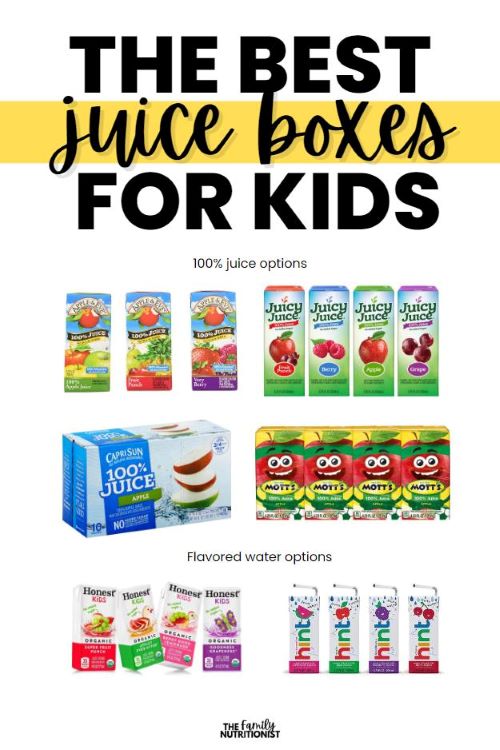
When choosing the best juice for kids, the main thing I want you to look for is 100% juice. Food and beverage marketing can get tricky, so don’t be fooled.
100% fruit juice is essentially the liquid from the fruit, with no added colors, preservatives or sugar.
Honestly, a 100% orange, apple, grape, or any 100% fruit juice is the best juice for kids in addition to water or milk as their primary beverage.
My favorite juice boxes for kids are:
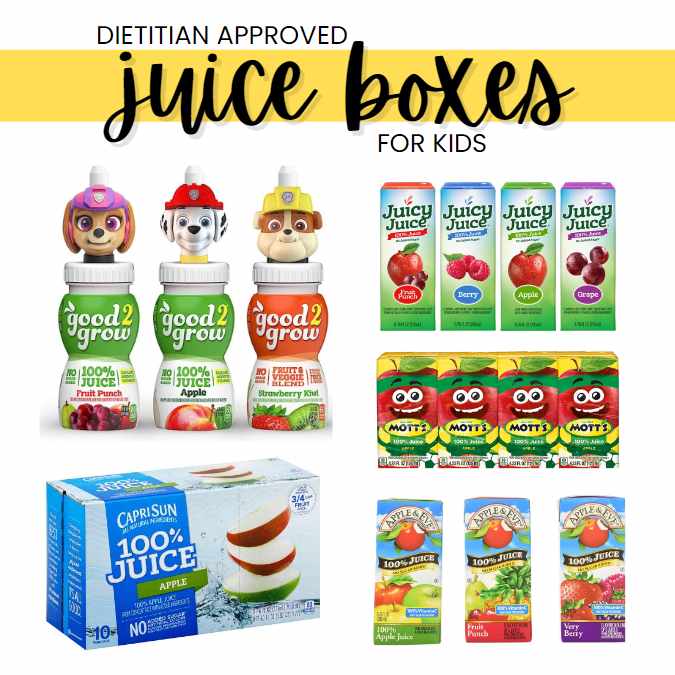
- Apple & Eve 100% Juice
- Good2Grow juice bottles
- Juicy Juice 100% Juice
- Mott’s 100% Juice
- Kirkland 100% Juice (Costco)
- Capri Sun 100% Juice
I can’t always find the 100% juice varieties I like at our local grocery store, so I’ll often purchase a large case of Amazon to last us a few months.
Favored Water for Kids
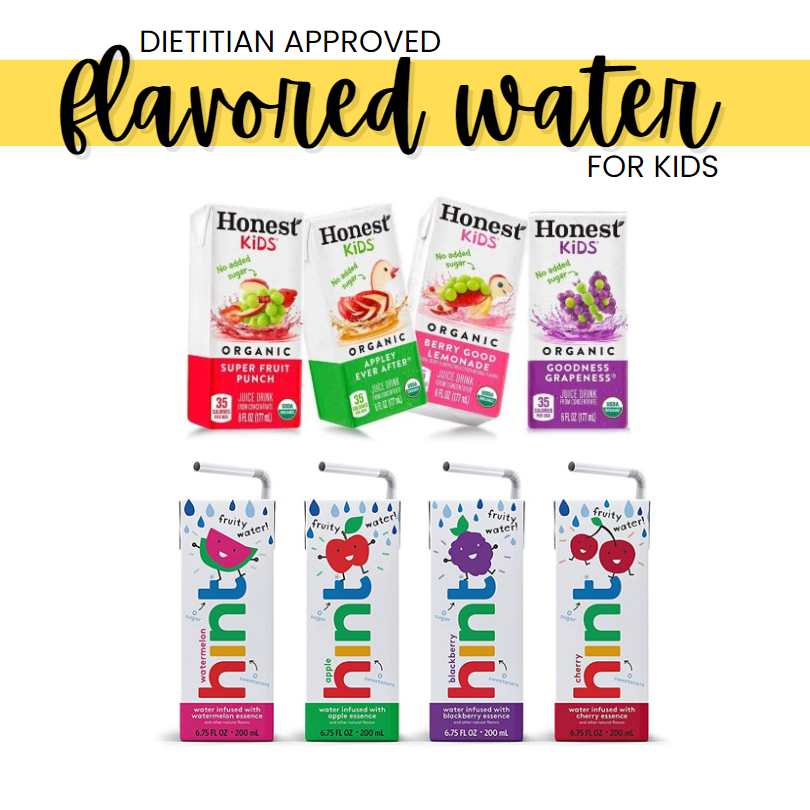
Flavored water can be a great option for kids, but I would take a look at the ingredients to see what flavoring is. Sometimes companies like to sneak in artificial sweeteners to give it flavor without the calories or needing to label any added sugar on the nutrition label.
My favorite flavored waters for kids are:
- Honest Kids Juice Drink – basically watered-down juice
- Hint Kid’s Water – water infused with fruit essence
- Rethink Water Organic Flavored Water for Kids
Carbonated Water for Kids
Again, not the end of the world, but most kids I’ve come across who try any carbonated beverage just think they’re “too spicy.”
I’d rather your child drink carbonated water than a regular sugar-sweetened soda though.
The only concern for carbonated water is the effect it may have on their teeth. The carbonation can erode the enamel of teeth, which ultimately protects them from decay.
Yes, your kids can drink carbonated water, but it shouldn’t be their main beverage throughout the day.
Are Artificial Sweeteners Safe for Kids?
This is a tough question because we just don’t know enough yet about the long-term effects of artificial sweeteners and kids.
Because of the unknown, the American Academy of Pediatrics recommends avoiding artificial sweeteners for kids.
Plus, artificial sweeteners and food additives like stevia are hundreds to thousands of times sweeter than regular sugar. If your child is used to this level of sweetness, they may start to prefer sweeter beverages over water.
Artificial sweeteners/sugar substitutes:
- Acesulfame potassium (Sweet One, Sunett).
- Advantame.
- Aspartame (NutraSweet, Equal).
- Neotame (Newtame).
- Saccharin (Sweet’N Low).
- Sucralose (Splenda).
- Luo han guo (Monk Fruit in the Raw).
- Purified stevia leaf extracts (Truvia, PureVia, others).
If your child does consume a beverage with artificial sweeteners, it’s not the end of the world. The point is not to consume them regularly and prioritize other beverages like water, milk, and even 100% fruit juices.
What Juice to Avoid
There are a lot of different words in marketing to describe beverages and producers have to follow specific rules, but that doesn’t mean they’re not tricky to understand or misleading.
Words to avoid when it comes to selecting the best juice for kids are “cocktail,” “beverage,” or “drink.” These labels mean the beverage may contain only small amounts of juice and larger amounts of added sugar and other ingredients.
At the end of the day, always look for 100% fruit juice on the label to ensure you’re selecting the best juice for kids.
What About Other Sugar-Sweetened Beverages?
Growing up, I made Kool-Aid all the time. I can still see the cup of white sugar dissolving in the pitcher of grape Kool-Aid.
Or what about those juice jugs that came in the shape of a barrel? I loved those!
Would I give them to my kids now? Maybe on occasion, but it’s not something I keep in the house or would recommend any parent to give their kids regularly.
These beverages are considered sugar-sweetened beverages, meaning there’s sugar added to them – duh. If you take a second to look at the nutrition label on the juice or juice box and it has added sugar, that’s what you want to avoid.
On average, kids consume more than 30 gallons of sugar-sweetened beverages per year. Because kids already get so much added sugar in their diets, sugar-sweetened beverages should be avoided or minimized as much as possible. But I get it, that’s not always realistic.
The point is, it’s okay for your kids to have some sugar-sweetened beverages, but it should be more uncommon than it is common.
Conclusion
At the end of the day, I never want you to micromanage your child’s diet (unless medically necessary), this includes how much juice they drink.
As the parent, you control what foods and beverages are available and if one of those is or isn’t juice, that’s totally up to you. What you can do to help your child make healthy beverage choices, is always prioritize water and when purchasing juice, the best juice for kids are the 100% juice varieties.